Evaluating the Space Elements Icons Set: A Flat Style Resource for Modern Web Design
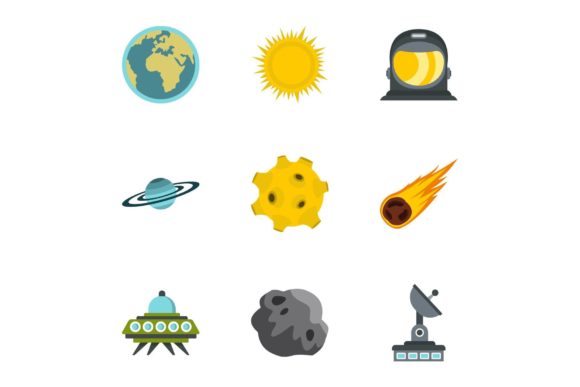
In the rapidly evolving landscape of web design, the choice of visual assets can significantly influence user engagement and brand perception. Among the myriad of resources available to designers, developers, and content creators, the Space Elements Icons Set, Flat Style stands out as a pragmatic solution for projects requiring celestial or scientific themes. This collection comprises nine distinct vector icons, each rendered in a clean, flat illustration style that aligns with contemporary interface trends. For professionals seeking to integrate space-related imagery without compromising load times or aesthetic consistency, understanding the specific utility and limitations of this set is essential.
The Appeal of Flat Design in Technical Illustration
Flat design has transitioned from a passing trend to a foundational principle in modern user interface (UI) development. Its primary strength lies in clarity; by removing unnecessary textures, gradients, and three-dimensional effects, flat icons communicate concepts quickly and effectively across various screen sizes. The Space Elements Icons Set, Flat Style leverages this philosophy to depict complex astronomical subjects—such as planets, rockets, satellites, and stars—in a simplified manner.
What makes this approach particularly valuable for web applications is scalability. Unlike raster images that pixelate when enlarged, the vector nature of these icons ensures they remain crisp on high-resolution displays, including Retina screens and 4K monitors. The flat style further enhances this by relying on solid color fills and distinct outlines, which render consistently regardless of the browser or operating system. For entrepreneurs and small business owners launching tech-focused startups or educational platforms, this reliability reduces the need for multiple asset versions, streamlining the development workflow.
Technical Versatility and File Format Options
A critical factor in evaluating any digital asset is its compatibility with existing workflows. This icon set distinguishes itself by offering a comprehensive range of file formats: JPG, EPS, AI, PSD, and PNG. This variety addresses the diverse needs of different professional roles within a project team.
- AI and EPS: These vector formats are indispensable for graphic designers using Adobe Illustrator. They allow for infinite scalability and the ability to modify anchor points, colors, and stroke weights. If a brand's color palette requires a specific shade of blue for a planet icon, the AI or EPS file enables precise customization without quality loss.
- PSD: For teams working primarily in Photoshop, the layered PSD files offer flexibility in compositing. Designers can easily add shadows, blend modes, or integrate the icons into complex mockups while maintaining editability.
- PNG: With support for transparency, PNGs are the go-to format for web developers needing ready-to-use assets. They can be dropped directly into HTML/CSS structures, ensuring immediate visual integration without additional processing.
- JPG: While less common for icons due to lack of transparency, JPGs are included for scenarios where file size is paramount and background blending is not required, such as in certain email newsletters or compressed blog headers.
The inclusion of both editable source files and ready-to-use raster formats demonstrates a thoughtful approach to usability. It acknowledges that a freelancer might need to tweak an icon's geometry, while a blogger might simply need to upload an image and publish. This dual capability enhances the long-term value of the set, making it a versatile addition to a creative toolkit.
Practical Applications Across Industries
The utility of the Space Elements Icons Set, Flat Style extends beyond obvious aerospace or astronomy contexts. In today's digital economy, space imagery often serves as a metaphor for innovation, exploration, and future-forward thinking. Consequently, this set finds relevance in several distinct sectors:
EdTech and Educational Publishing
Educators and publishers creating online courses about physics, geography, or general science can utilize these icons to break up text-heavy content. The flat style is particularly effective in educational materials as it reduces cognitive load, allowing students to focus on the concept rather than decorative details. For instance, a module on the solar system can use the planet icons as bullet points or section dividers, maintaining a cohesive visual language throughout the curriculum.
Technology Startups and SaaS Platforms
For software-as-a-service (SaaS) companies, especially those dealing with cloud computing, data storage, or satellite communications, space imagery is a natural fit. A "cloud" server can be visually represented alongside a satellite icon to imply global reach and connectivity. The clean lines of the flat style ensure these icons do not clash with the minimalist interfaces typical of modern dashboards and admin panels.
Marketing and Branding Agencies
Marketers often require thematic assets for campaign landing pages or social media graphics. When promoting a product launch framed as a "mission" or a "leap forward," these space elements provide immediate visual context. The consistency of the nine-icon set ensures that all marketing collateral maintains a unified look, reinforcing brand identity across different channels.
Assessing Quality and Consistency
When integrating external assets into a project, consistency is paramount. A common pitfall with free or low-cost icon packs is the variation in stroke width, color saturation, or perspective among different icons. Upon reviewing the Space Elements Icons Set, Flat Style, one observes a deliberate effort to maintain uniformity. The line weights appear consistent across all nine elements, and the color palette is harmonized to prevent any single icon from feeling out of place.
This level of coherence is crucial for professional presentation. Inconsistent icons can make a website feel disjointed or amateurish, undermining user trust. By providing a curated set where every element adheres to the same design rules, this resource saves designers the time-consuming task of manually adjusting individual icons to match. It allows them to focus on layout and functionality rather than fixing visual discrepancies.
Limitations and Considerations for Implementation
While the Space Elements Icons Set, Flat Style offers significant advantages, it is important to recognize its scope and limitations to manage expectations realistically. The set contains nine icons, which is a focused selection rather than an exhaustive library. For large-scale projects requiring dozens of unique space-related symbols—such as a detailed interactive star map or a comprehensive encyclopedia app—this set may serve best as a supplementary resource rather than the sole iconography solution.
Additionally, the flat style, while popular, may not suit every brand aesthetic. Organizations with a highly realistic, photographic, or skeuomorphic design language might find these simplified illustrations too abstract. In such cases, these icons could still be used effectively as secondary elements, such as favicons or loading indicators, where simplicity is preferred over detail.
Furthermore, although the vector formats allow for color changes, users should be mindful of contrast ratios when customizing colors for accessibility. The original color choices are likely optimized for readability, but significant deviations could impact users with visual impairments. It is the responsibility of the implementer to ensure that any customized versions meet WCAG (Web Content Accessibility Guidelines) standards.
Making the Decision: Is This Set Right for Your Project?
Deciding whether to incorporate the Space Elements Icons Set, Flat Style into your workflow depends largely on your specific project requirements and design goals. If you are a web developer building a landing page for a new telescope app, an educator designing a slide deck on the cosmos, or a marketer crafting a campaign about innovation, this set provides a high-quality, ready-to-deploy solution.
The value proposition here is efficiency combined with professionalism. Instead of commissioning a custom illustrator or spending hours searching for mismatched free icons, you gain access to a cohesive, multi-format package that integrates seamlessly into both design and development environments. The availability of AI, EPS, and PSD files ensures that you retain control over the visuals, while the PNG and JPG options facilitate quick deployment.
In conclusion, the Space Elements Icons Set, Flat Style represents a solid investment for professionals who prioritize clean aesthetics and technical flexibility. Its adherence to flat design principles ensures longevity in an era where minimalism dominates UI trends. While it may not cover every conceivable space-related scenario due to its limited count, the quality and versatility of the included nine icons make it a highly effective tool for enhancing the visual communication of web-based projects. For those looking to add a touch of cosmic inspiration to their digital presence without sacrificing performance or consistency, this collection warrants serious consideration.